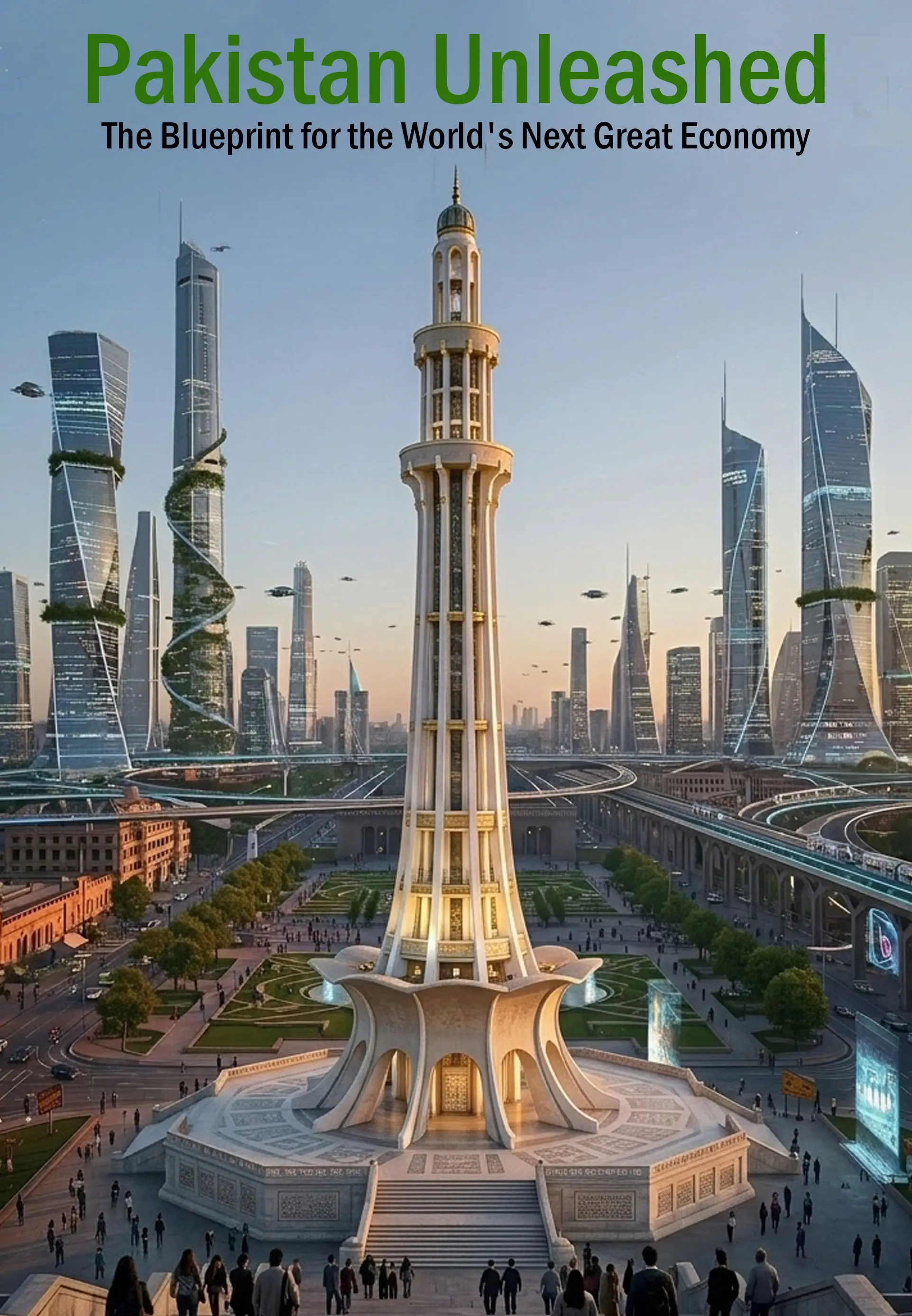
The Blueprint for the World's Next Great Economy
The first book to make the economic case for Pakistan's transformation with full calculation transparency. Every projection in this book has a formula. Every recommendation has a revenue model. Every risk has a number attached to it.
Each chapter makes the case for one reform, shows the full revenue model, and stress-tests the assumptions. The final chapter synthesises the master scenario.
How a UAE-style flat tax — 5% personal, 9% corporate — would expand Pakistan's tax base from 5.6 million to 50+ million taxpayers and double government revenue within five years.
Fintech, e-commerce, digital payments, and the property market. How formalisation of Pakistan's digital and physical asset base unlocks the single largest untapped revenue source.
Pakistan's car import duties are among the highest in the world. Removing them creates a larger, transparent, taxable market — and the total fiscal outcome is better, not worse.
CPEC, Gwadar, and the geopolitical case for Pakistan as Central Asia's trade gateway. Full transit revenue model and GDP contribution calculation.
K2. Hunza. Lahore's Mughal heritage. Pakistan has some of the world's most extraordinary tourism assets and fewer visitors than Liechtenstein. The infrastructure investment thesis.
The Indus irrigation system feeds 220 million people and exports $3.5B. With cold chain, food processing, and water efficiency, it could be a $25B+ export economy.
How Special Economic Zones attract the manufacturing FDI that transforms Pakistan from a textile exporter into a diversified industrial economy. The SEZ model from China, Bangladesh, and Vietnam applied to Pakistan.
Load-shedding is not a power shortage — it is a governance failure. PKR 2.6T in circular debt. The full technical, fiscal, and political solution — and why energy reform is the precondition for everything else.
26 million out-of-school children. 58% literacy. A STEM talent pipeline that, if activated, could compete with India's IT sector within a decade. The full ROI calculation on education investment.
25,000 medical graduates annually. $700M in pharmaceutical exports. The case for Pakistan as a medical tourism hub and pharmaceutical exporter — with full revenue models.
All 11 reforms in sequence. The compounding effect. The 10-year GDP trajectory from $374B to $1T+. The risk-adjusted case. What Pakistan looks like in 2035 if enough goes right, in the right order.
The only rigorous, quantified, sector-by-sector investment thesis for Pakistan. Every projection is transparent, every assumption is documented, and every model is stress-testable on the companion website.
A sequenced reform blueprint with revenue models attached. Each reform is costed, its dependencies mapped, and its political defensibility assessed. This is not a wishlist — it is a workplan.
The first data-backed, honest, non-partisan case for Pakistan's potential — for Pakistanis who need to see the numbers, not just the sentiment. And for the diaspora deciding whether to invest, return, or advocate.
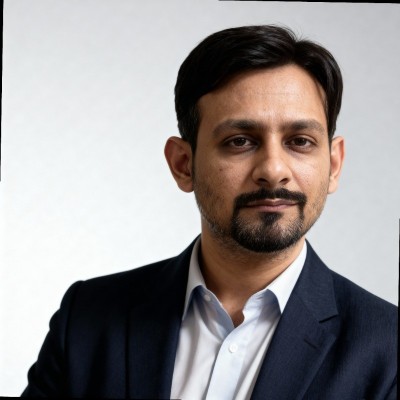
Muhammad Bilal is an engineer, AI architect, and founder based in Sharjah, UAE. A Pakistani national with over fourteen years of experience building production technology systems, he is the Global AI Ambassador for the UAE and CTO at the Global AI Forum (GAFAI). He is the founder of GeoBlood — a US 501(c)(3) nonprofit blood donor platform backed by Apple, Microsoft, and Google, operating across four countries.
This project grew out of a question that seemed simple but had no satisfying answer: if Pakistan adopted UAE-style tax architecture, what would the GDP impact be? The models were first built to answer that question — before expanding into the comprehensive eleven-sector blueprint this book and website represent.
Muhammad Bilal is the author of ten published books spanning artificial intelligence governance, economic policy, technology entrepreneurship, and fiction — including The AI Codex, VC Decoded, and The Executor: A Study of Shehbaz Sharif. The simulation models are calibrated against publicly available data from the World Bank, IMF, FBR, SBP, and PBS. PakistanUnleashed.com is the interactive companion to the book of the same name, published in 2026.
Read the full about page →"Finally, an economic case for Pakistan that is built on models, not sentiment. This is what Pakistan has been missing — a rigorous, data-first argument for transformation."
"The interactive models are exceptional. Being able to stress-test every assumption in real time changes how you engage with the argument. This is the future of policy writing."
"Essential reading for anyone making investment decisions about South Asia. The sectoral analysis is the most detailed I have seen on Pakistan — and the reform sequencing makes strategic sense."
Get your copy of Pakistan Unleashed — the most detailed, data-backed economic blueprint ever written for Pakistan. Available now in Kindle and paperback.